
In Short:
Despite clear goals and existing pathways towards a sustainable future, our society is not changing its behaviour accordingly. The Three-Horizon-Framework distinguishes between different levels of change. Using the framework, this article argues that most of our current environmental and policy debates do not go far enough, as they try to ‘fix’ the current system instead of collectively creating a desirable future, based on a mindset where everyone can thrive.
In today’s newspapers, social media, or television, we encounter a wealth of articles, posts and programmes discussing the climate crisis, the democracy crisis and growing societal inequality. Alongside the abundant information and knowledge presented, these articles typically offer clear suggestions on how to address the crises. Experts are interviewed, reports are shared, or the author herself offers an opinion on which steps to take regarding a specific topic. Yet, despite all these proposed solutions, a clear target on global emissions, and the existence of 17 sustainable development goals, our society is not changing at the necessary speed.
What if a crucial element was missing in our efforts to translate knowledge into action? What if the worldviews and paradigms underlying our environmental and social crises played a role in this gap?
The Three-Horizon model by Bill Sharpe illustrates how change occurs on different levels of thinking and how that is related to the multi-crises we are facing.
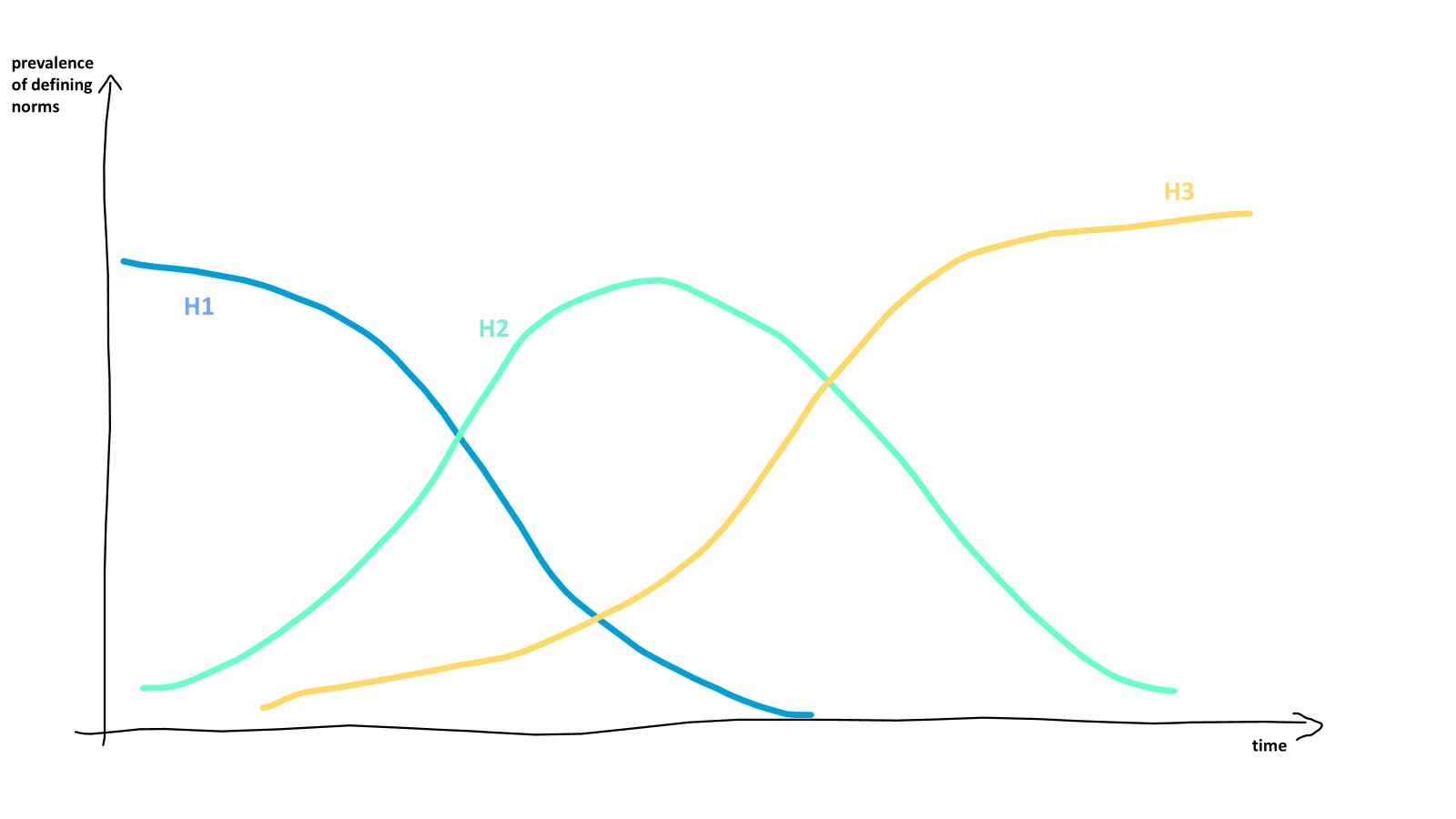
The Three-Horizons-Framework describes different levels of change. Horizon 1 (H1) represents the ‘business as usual’ world that is losing its fit for purpose. H1 raises the question of ‘what do we want to let go?’ with typical examples being the fossil fuel industry, unsustainable practices, or unhealthy habits that we aim to phase out.
Horizon 3 (H3) represents the long-term vision and successor to business-as-usual. It involves genuine transformative shifts from the present, using a new mindset and paradigm to envision and build a desired future in which all beings can thrive.
Horizon 2 (H2) represents a ‘world in transition’ with feasible activities and innovations that can transform and disrupt H1. Some of these innovations might be adopted by H1 systems to prolong their life, while others help H3 systems to emerge.
How does this relate to environmental change and the knowledge-action gap?
Since 194 countries signed the Paris Agreement in 2015 and agreed to limit the global temperature increase to 1.5 degrees, any economic thought, technological innovation or political decision that ignores the effects of our industries on the environment can be clearly attributed to an H1 system. Most of the science and policy support currently used in international negotiations and politics is based on a worldview that clearly acknowledges the harm our lifestyles inflict on nature (e.g. the biodiversity crisis) and on each other (e.g. growing economic inequality). Yet, the suggested solutions aim at avoiding or compensating for damages (economists call this internalizing externalities) by taxing pollution, introducing social support structures, or setting environmental protection zones. Thus, these suggestions envision a return to the status-quo by ‘fixing’ the current system and do not question the root causes of environmental destruction.
The mindset underlying current environmental sciences and politics is still an H1 mindset that assumes we are dependent on economic growth and that is based on scarcity, individualism and reductionism (see The Courage for More Complexity).
The H2 system tries to ‘solve’ our environmental and social problems but will not succeed in the long-term as its underlying H1 mindset will always hold it back from true transformation. An example includes sustainability-oriented investment portfolios (ESG funds) that still need to guarantee a growing return on investment as they operate under the current financial system.
Nora Bateson, a Club of Rome Member and systems thinker, describes this situation by asking “What if the caterpillar was trying to design a sustainable way to be a caterpillar, as he could not imagine what it was like to be a butterfly?”.
Most of the solutions to the environmental crisis currently put forward in political debates and negotiations are sustainable-caterpillar-solutions. Despite good intentions, we might inadvertently propagate an old mindset.
The poet and philosopher Bayo Akomolafe summarizes this as “What if the way we respond to the crisis is part of the crisis?”.
So, how could a H3 world look like?
A mindset shift is not something that should be prescribed from the outside, it’s not something that should be predetermined or ‘solved’. The mindset shift (H3 thinking) Aweledge wants to cultivate is a qualitative change in making sense of the world, rather than a change of goals or envisioned outcomes.
“Our culture is addicted to ‘endpoints’ and ‘outcomes’ and sees the world through a lens of strategy,” comments Nora Bateson. Even the concepts of how to get out of problems, such as the unsustainable resource use, are produced from within the loop of explicitly defining and strategizing change in terms of measurable ‘results’ or ‘progress’.
Unfortunately, solving the environmental and climate crisis has become a linear endpoint towards which we race in our old mindset of faster, cheaper and more. Instead, we need to cultivate an ecological way of thinking that attends life.
Awledge invites you to ask: What if we did not go faster and more efficient in times of urgency but went slower, deeper and allowed for the emergence of something new? What if we allowed for a new quality to unfold instead of further urging into the wrong direction? What if we dared to sit for a while with our problems, sank deeper into underlying layers of complexity, and opened for new ideas and inspirations to emerge?’
Awledge opens a space for exploration and experimentation of an H3 horizon. A plethora of practices and methods is available to delve deeper into complexity and collectively build a vision for an H3 world.