
In Short:
Bridging the knowledge-action gap requires paying attention to the ‘affective’ sphere of emotions, perceptions and the non-cognitive, a blind spot in current sustainability debates. Experiential learning that encompasses cognitive, affective and behavioural aspects can help to expand one’s perception, derive meaning from scientific knowledge and develop an impulse for individual and collective action.
“There is an assumption that once we know what needs to be done, then mobilization, organization, decisions, and action will follow. Yet this assumption has again and again failed to produce results at scale, suggesting that closing the gap between knowledge and action calls for qualitatively different approaches to understanding and activating transformations to sustainability”, write the sociologists Bentz, O’Brien, and Scoville-Simonds about transformation.
How could such ‘qualitatively different approaches’ look like?
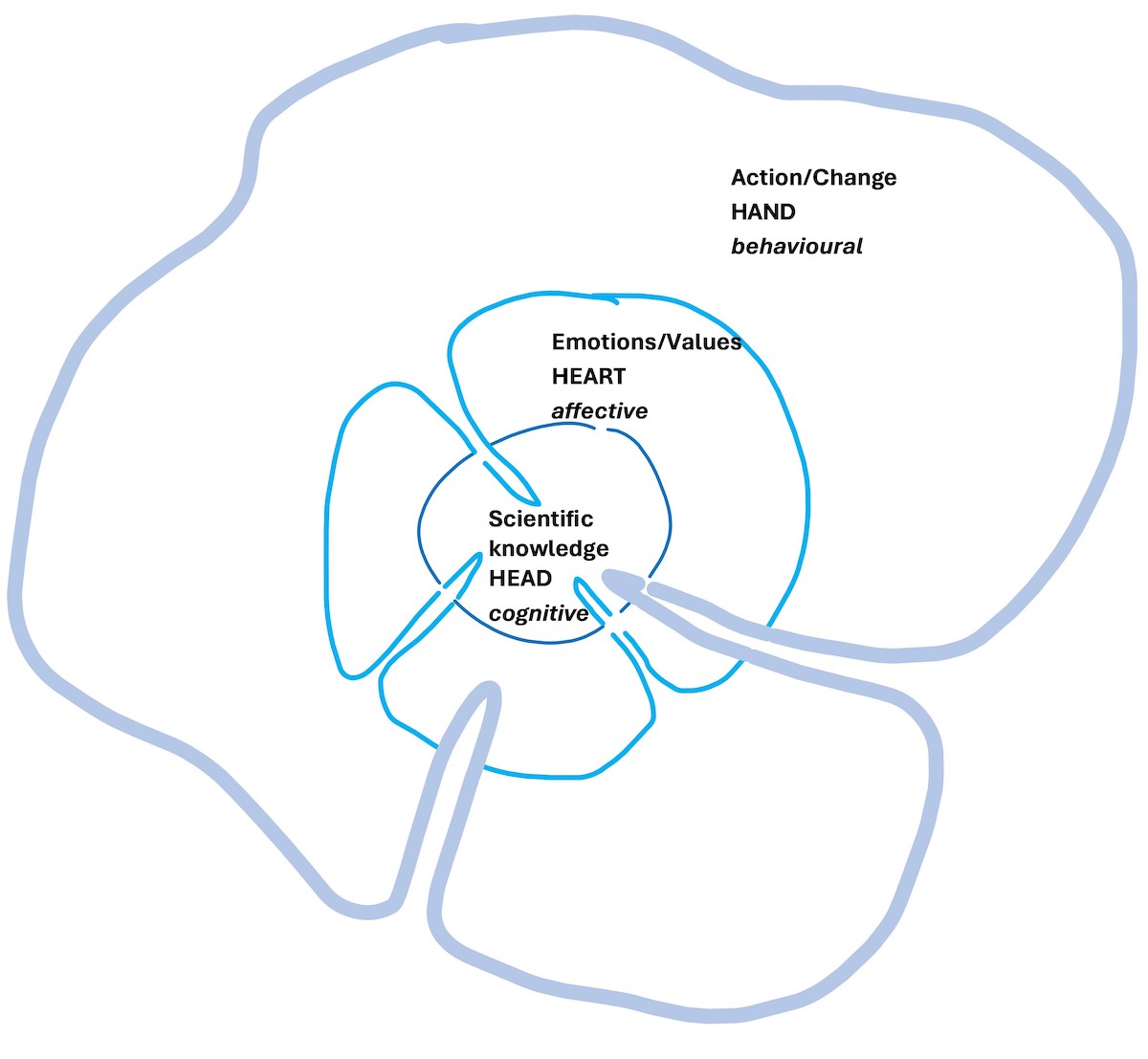
Aweledge proposes a definition of ‘qualitatively different’ as a space between scientific knowledge (the cognitive) and action (the behavioral) related to climate change and societal transformation towards sustainability.
‘Qualitatively different’ involves the arts and aesthetics; it incorporates body knowledge and the ‘affective’ in the sense of feelings, emotions, perception, intuition, and the non-cognitive. In Aweledge, this ‘qualitatively different space’ serves as a catalyst to transform knowledge into action and offers an explanation as to why, so far, we are not able to bridge the knowledge-action gap:
Current environmental science, politics, and the civil society sector operate under the assumption that society can jump straight from knowledge into action and experience increasing frustration because the required change on a societal level is not occurring. Aweledge is based on the assumption that this inertia is a consequence of the ignorance of the affective sphere in our culture.
The affective sphere, which I call the heart sphere here, is a blind spot in Western society today, outsourced to private life, one’s therapy session, or an artistic hobby. Environmental studies, recommendations for decision-making, and policy reports are solely based on cognitive reasoning. However, there is increasing backlash against this omission from various scientific disciplines.
A diverse group of psychologists, sociologists, cognitive scientists, computer scientists, and philosophers recently declared the rise of ‘affectivism,’ criticizing that for too long, the inclusion of emotions, feelings, and other affective processes in models of human behavior was seen as irrational and unmeasurable. ‘Emotions are not just about what is but also about what matters,’ they write.
What if we paid more attention to what matters? And how can we find out about what matters to us?
Aweledge helps you build an ‘affective muscle’ to derive meaning from scientific knowledge and transform meaning into an impulse for action. It draws on several academic disciplines that offer insights in that regard.
The sociologist Hartmut Rosa uses the term ‘resonance‘ to describe our relationship to the world and a fundamental human quest for ‘resonant’ relationships. A resonant relationship with nature is not established through cognitive learning processes and rational insights but results from practical activities (behavioral) and emotionally meaningful (affective) experiences, he writes.
The psychologist Dacher Keltner spent many years studying ‘awe‘, a feeling of vastness that transcends our current understanding of the world. His research showed that in a state of awe, the sense of self diminishes; we experience a greater sense of humility; we feel as part of a greater ecology and are more inclined to collaborate. Awe can be induced by cultural activities such as art, music, and dance but also, and especially, by nature such as the beauty of landscapes or the scents of rosemary in the garden.
The biologist E.O. Wilson coined the term ‘biophilia‘ to describe how people are deeply affiliated with and drawn to nature and living systems. Wilson suggests that it is in people’s personal interest to preserve the human connection to nature, as it benefits future generations, other organisms, and each individual human experience.
In the field of education, experiential learning that combines head, heart, and hand is advocated as a holistic approach that enables transformative learning experiences. They involve increased perception (cognitive), expanded value (affective), and active application of learned concepts (behavioral).
A transformative experience refers to seeing and valuing the world in new ways, for example, through art. It includes the expansion of perception by seeing the world through new lenses and by that, perceiving deeper layers of meaning. Experiential learning questions the monopoly of rationalism compared to humanist qualities such as intuition, creativity, and ethics. It calls out value-free scientific objectivity as an illusion and worries about learning devoid of story, attachment, and meaning.
Building on this wide range of scientific findings, Aweledge offers a holistic learning and sense-making experience. It derives meaning from scientific knowledge about climate change and other environmental topics for individuals or groups. It creates a sense of community, resonance, and awe. Emerging from such a sense of interconnectedness and interdependence, it finally derives an impulse for individual and collective action.